Functions: Higher degree polynomials
 Higher degree inequalities
In the same manner as when solving a quadratic inequality, we can also solve an inequality with higher degree polynomials.
Solving a higher degree inequality
| Procedure | Example | |
| We solve the following inequality \[\blue{f(x)} \gt \green{g(x)}\] in which #\blue{f(x)}# and #\green{g(x)}# are polynomials. | #\blue{x^6+x^3+6} \gt \green{-2x^3+10}# (resp. solid and dashed)  The solution is #x \lt \sqrt[3]{-4} \land x \gt 1#. |
|
| Step 1 | We solve the equality \[\blue{f(x)} = \green{g(x)}\] | |
| Step 2 | We sketch the graphs #\blue{f(x)}# and #\green{g(x)}#. | |
| Step 3 | With the help of step 1 and 2, determine for which values of #x# the inequality holds. In a coordinate system, the biggest graph is the one above the other. |
Please note that this procedure also holds for the inequality signs #\geq# and #\leq#, only now the #x#-values of the intersection points are also part of the solution.
#t\gt -4^{{{1}\over{3}}}\land t\lt 5^{{{1}\over{3}}}#
| Step 1 | We solve the equality #t^6-t^3+9\cdot t+58=9\cdot t+78#. This is done like this: \[\begin{array}{rcl} t^6-t^3+9\cdot t+58&=&9\cdot t+78 \\ &&\phantom{xxx}\blue{\text{original equation}}\\ t^6-t^3-20&=&0 \\&&\phantom{xxx}\blue{\text{reduced to }0}\\ \left(t^3-5\right)\cdot \left(t^3+4\right)&=&0 \\&&\phantom{xxx}\blue{\text{left hand side factorized}}\\ t^3-5=0 &\lor& t^3+4=0 \\&&\phantom{xxx}\blue{A\cdot B=0 \text{ if and only if }A=0\lor B=0}\\ t=5^{{{1}\over{3}}} &\lor& t=-4^{{{1}\over{3}}} \\&&\phantom{xxx}\blue{\text{constant terms to the right hand side and taken the root}}\\ \end{array} \] |
| Step 2 | We sketch the graphs #y=t^6-t^3+9\cdot t+58# (blue) and #y=9\cdot t+78# (green dashed). 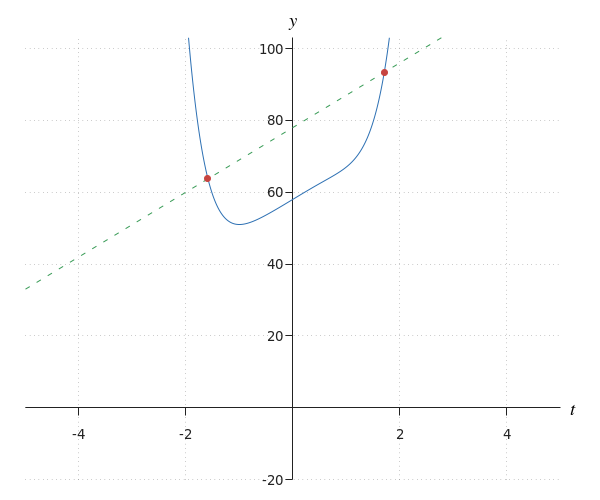 |
| Step 3 | We can read the solutions to the inequality from the graph. \[t\gt -4^{{{1}\over{3}}}\land t\lt 5^{{{1}\over{3}}}\] |
Unlock full access

Teacher access
Request a demo account. We will help you get started with our digital learning environment.