Linear formulas and equations: Linear equations and inequalities
 Intersection points of linear formulas with the axes
Intersection point with the x-axis
Example
Example
Consider the formula #y=-3 \cdot x - 4#.
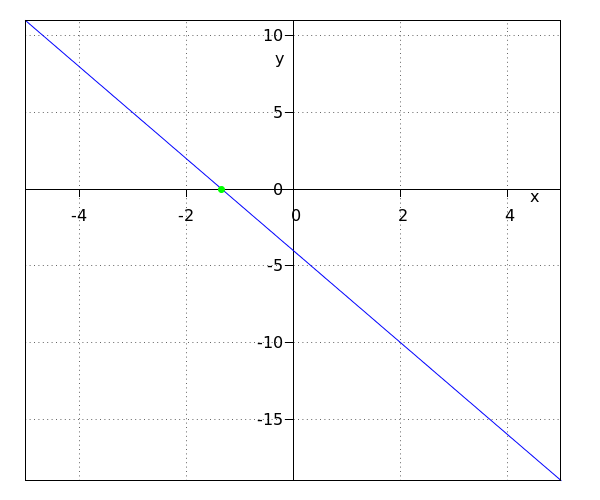
The intersection point with the #x#-axis can be found by solving #-3 \cdot x-4=0#.
\[\begin{array}{rcl}-3 \cdot x -4 &=& 0\\ && \phantom{xxxxx}\color{blue}{\text{the equation}} \\ -3 \cdot x &=&4 \\&& \phantom{xxxxx}\color{blue}{\text{both sides plus }4} \\x&=&-\frac{4}{3}\\ && \phantom{xxxxx}\color{blue}{\text{both sides divided by}-3} \end{array}\]
Hence, the intersection point with the #x#-axis is: #\rv{-\frac{4}{3},0}#.
Intersection point with the y-axis
Example
Example
Consider the formula #y=-3 \cdot x - 4#.
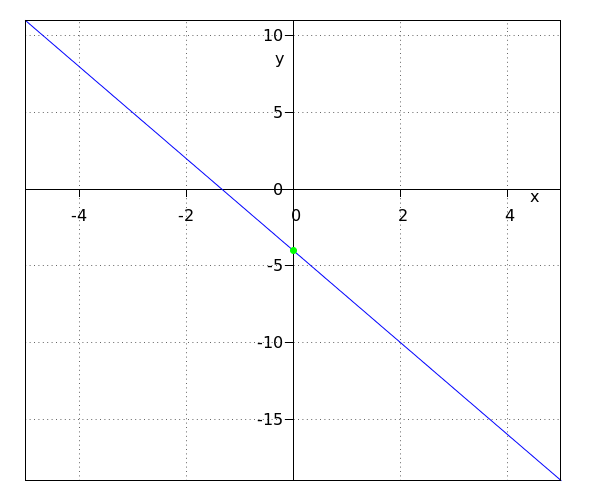
The intersection point with the #y#-axis can be found by substituting #x=0# in #y=-3 \cdot x -4#. This gives:
\[y=-3 \cdot 0-4 =-4\]
Hence, the intersection point with the #y#-axis is: #\rv{0,-4}#.
#q=-10#
Because if #\rv{p,0}# lies on the line, then #-10 p + 7\cdot 0 = -70# applies (this follows from entering #x=p# and #y=0# in #-10 x + 7 y = -70#). This is a linear equation with unknown #p#, where #p=7# is the solution.
Similarly, entering #x=0# and #y=q# in the equation #-10 x + 7 y = -70# gives the linear equation #7\cdot q = -70# with solution #q=-10#.